

In Ruffenach v. Deutsche Bank National Trust Co., No. 6D2023-1482 (Fla. 6th DCA Mar. 20, 2026), Florida’s Sixth District Court of Appeal held that trial courts are not categorically required to hold an evidentiary hearing or receive expert testimony before awarding attorney’s fees, and certified conflict with prior decisions of Florida’s other district courts of appeal. The opinion is available on FindLaw, and a PDF copy is linked at the end of this post.
Issue
The question in Ruffenach v. Deutsche Bank was whether the trial court erred in awarding Deutsche Bank its attorneys’ fees in a foreclosure action without (a) an evidentiary hearing and (b) expert testimony, and despite the absence of itemized time records.
Facts
- Deutsche Bank obtained a foreclosure final judgment against Charles Ruffenach in Orange County, which included a line item labeled “Recoverable Balance” that both parties agreed encompassed an award of attorneys’ fees (and possibly other costs).
- The trial court entered this fee award without holding an evidentiary hearing, without receiving expert testimony on the reasonableness of the fees, and without Deutsche Bank submitting records detailing the work its attorneys performed.
- On appeal, Ruffenach challenged only the fee component, arguing (1) lack of evidentiary hearing, (2) lack of expert testimony, and (3) absence of supporting time records; the Sixth DCA affirmed the foreclosure judgment itself.
Rule
- Under Florida Patient’s Compensation Fund v. Rowe, a court must apply the lodestar method: determine reasonable hours, determine a reasonable hourly rate, and multiply to reach a reasonable fee, possibly adjusting for contingency risk and results obtained.
- As Ruffenach v. Deutsche Bank explains, no Florida statute or rule requires (i) an evidentiary hearing or (ii) expert testimony as a universal prerequisite to awarding fees under a statute, rule, or contract; the longstanding “requirements” were judicially created (tracing back to Lyle v. Lyle and progeny).
- The Florida Supreme Court has not issued a binding holding that trial courts must always have expert testimony or an evidentiary hearing to award attorneys’ fees; prior contrary statements (e.g., in Crittenden) are treated as dictum.
- Trial judges are “experts” on reasonable fees (rates and hours) and may rely on affidavits, their own experience, and the record; in the absence of material factual disputes other than reasonableness of hours and rates, an evidentiary hearing is not required.
- However, the party seeking fees must present legally sufficient evidence, including records detailing the work performed, to allow a Rowe analysis.
How the Sixth DCA Ruled in Ruffenach v. Deutsche Bank
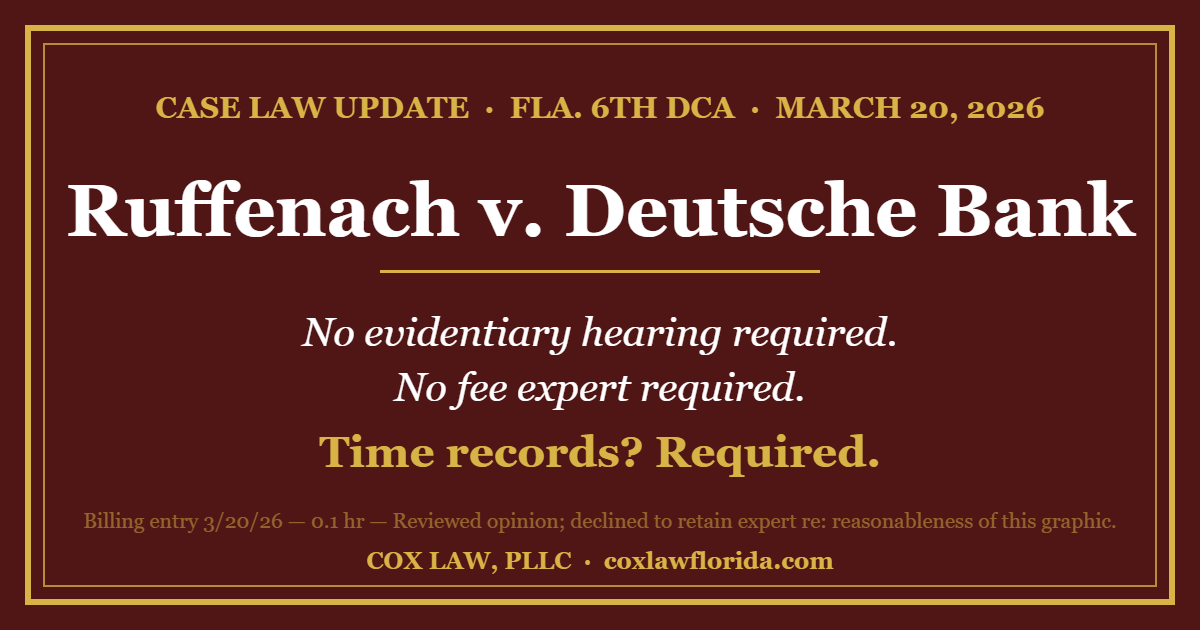
- On the first two challenges in Ruffenach v. Deutsche Bank, the Sixth DCA rejected Ruffenach’s argument that the trial court was categorically required to hold an evidentiary hearing and receive expert testimony before awarding fees.
- The court expressly receded from the uniform district-court line requiring both an evidentiary hearing and expert testimony in every fees case, holding instead that those mechanisms are not always necessary: judges can act as experts on rates and hours, and affidavits may suffice where there are no material factual disputes beyond reasonableness of hours and rates.
- Nonetheless, the bank wholly failed to submit time records or other documentation showing the work its attorneys performed, leaving the trial court without the evidentiary foundation Rowe requires to determine reasonable hours and to perform a lodestar calculation.
- Because the absence of detailed time records meant there was not legally sufficient evidence to support the amount of the fee awarded, the fee component of the judgment could not stand, irrespective of the lack of hearing or expert testimony.
- The bank requested a remand to prove attorneys’ fees (and any non-fee components included in “Recoverable Balance”), but the appellate court declined, reasoning that the bank had already had its trial-level opportunity to prove its damages and fees and could not obtain a second evidentiary bite simply because it failed to carry its burden initially.
Ruffenach v. Deutsche Bank: Takeaways for Fee Motions
In Ruffenach v. Deutsche Bank, the Sixth DCA affirmed the foreclosure judgment but reversed the attorneys’ fee award, holding that trial courts are not categorically required to conduct evidentiary hearings or receive expert testimony before awarding fees, yet must have sufficient evidence—such as detailed time records—to perform the Rowe lodestar analysis; because Deutsche Bank failed to submit such records, the fee award (the “Recoverable Balance” component) was stricken and the case remanded only to enter an amended judgment omitting that award, with no opportunity for the bank to re‑prove fees.
Related Posts
- Invoices Speak Louder than Words: 6th Certifies Conflict on Fees
- Guerin v. Countryside North: Yes, Specific Findings are Necessary under Rowe
- Borrower Wins Foreclosure but Loses on Attorney’s Fees
Full Opinion
The full Ruffenach v. Deutsche Bank opinion may be downloaded here: