

Binger v. King Pest Control, 401 So. 2d 1310 (Fla. 1981) (England, J.; Adkins, Boyd, Overton, Alderman, and McDonald, JJ., concurring; Sundberg, C.J., dissenting). Review of King Pest Control v. Binger, 379 So. 2d 660 (Fla. 4th DCA 1980). Decision of the district court approved; new trial stands.
The Binger test is the standard every Florida trial court applies when a party calls a witness who was never disclosed under a pretrial order. Decided in 1981, Binger v. King Pest Control is still the controlling authority, and its prejudice-first, four-part analysis is quoted in nearly every Florida opinion on undisclosed witnesses. Here is the case in brief.
Facts
Parties. Robert Dennis Binger and his wife were the plaintiffs below and the petitioners in the Supreme Court. King Pest Control was the defendant and respondent. The civil action arose out of an accident; the liability fight turned on accident reconstruction.
The pretrial order. The trial court entered a pretrial order requiring each side to exchange witness lists at least 20 days before trial.
What happened. King Pest Control complied. More than a month before trial it disclosed Burton Murrow, an accident reconstruction expert. Four days before trial the Bingers deposed Murrow and then retained their own expert to scrutinize his deposition testimony. They never disclosed that expert. Their list referred only generically to “any and all necessary” impeachment or rebuttal witnesses. At trial, after Murrow testified, the Bingers called their undisclosed expert to impeach him. King Pest Control objected, and the trial court allowed the testimony anyway.
Below. King Pest Control appealed. The Fourth District reversed and remanded for a new trial. The Florida Supreme Court accepted jurisdiction to reconcile conflicting district court decisions on the effect of a pretrial failure to disclose witnesses, including Mall Motel Corp. v. Wayside Restaurants, Inc., 377 So. 2d 41 (Fla. 3d DCA 1979).
Issues
- Does a pretrial order requiring the exchange of witness names reach witnesses a party intends to call only for impeachment or rebuttal?
- What standard governs a trial court’s discretion to admit or exclude a witness who was not disclosed as the pretrial order required?
Holding
Issue 1 — Yes. A pretrial order directing the parties to exchange the names of witnesses “requires a listing or notification of all witnesses that the parties reasonably foresee will be called to testify, whether for substantive, corroborative, impeachment or rebuttal purposes.” A general reference to “any and all necessary” impeachment or rebuttal witnesses is inadequate disclosure.
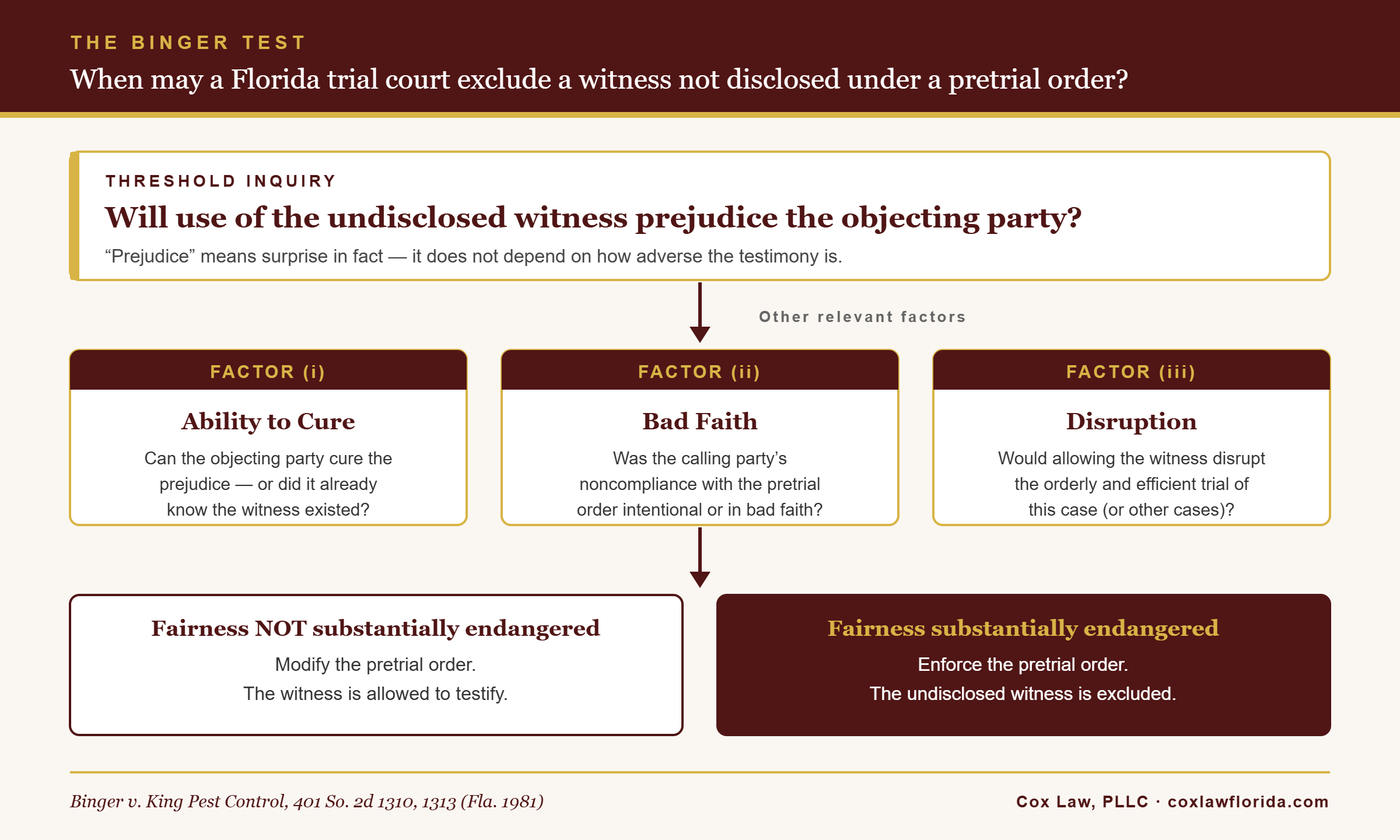
Issue 2 — The Binger test. Whether to exclude the undisclosed witness rests in the trial judge’s discretion, but that discretion must be guided largely by prejudice to the objecting party, meaning surprise in fact, together with three further factors: (i) the objecting party’s ability to cure the prejudice or its independent knowledge of the witness; (ii) the calling party’s intentional or bad-faith noncompliance; and (iii) the disruption an unlisted witness would cause to the orderly and efficient trial of the case. If, after weighing these factors, the court concludes that using the witness will not substantially endanger the fairness of the proceeding, it should modify the pretrial order and let the witness testify. Applied here, the Bingers’ nondisclosure was intentional and King Pest Control was prejudiced, so the Fourth District was right to order a new trial.
Rationale
Discovery is meant to end trial by ambush. Drawing on Dodson v. Persell, 390 So. 2d 704 (Fla. 1980), the Court reiterated that litigation is a search for truth on the relevant facts, not an exercise in gamesmanship, surprise, or superior trial tactics. Pretrial disclosure of witnesses serves two goals the Court considered central: it eliminates surprise, and it encourages settlement by letting each side evaluate the other’s proof.
“Impeachment” is not a loophole. If a party could hold back any witness simply by labeling him an impeachment or rebuttal witness under a blanket reservation, the disclosure requirement would mean little. The Court therefore read the pretrial order to cover every witness a party reasonably foresees calling, whatever the purpose of the testimony. The Bingers reasonably foresaw calling their expert; they had hired him specifically to answer Murrow.
Discretion, but not blind discretion. The Court adopted the Fourth District’s view that the trial judge, who sees the case unfold, is best positioned to decide whether an unlisted witness should testify. It rejected any per se rule of exclusion. But it insisted on a structured inquiry, the passage now known as the Binger test:
The discretion to do so must not be exercised blindly, however, and should be guided largely by a determination as to whether use of the undisclosed witness will prejudice the objecting party. Prejudice in this sense refers to the surprise in fact of the objecting party, and it is not dependent on the adverse nature of the testimony. Other factors which may enter into the trial court’s exercise of discretion are: (i) the objecting party’s ability to cure the prejudice or, similarly, his independent knowledge of the existence of the witness; (ii) the calling party’s possible intentional, or bad faith, noncompliance with the pretrial order; and (iii) the possible disruption of the orderly and efficient trial of the case (or other cases). If after considering these factors, and any others that are relevant, the trial court concludes that use of the undisclosed witness will not substantially endanger the fairness of the proceeding, the pretrial order mandating disclosure should be modified and the witness should be allowed to testify.
Binger, 401 So. 2d at 1313–14.
Prejudice means surprise, not damage. Under the Binger test, prejudice is defined as surprise in fact. That the undisclosed testimony hurts the objecting party is not the point; every effective witness hurts someone. The question is whether the objecting party was caught unprepared in a way it could not fix.
Applying the Binger test. The Bingers offered only one justification for withholding their expert’s name: a belief that they could impeach King Pest Control’s expert as a surprise tactic. That was intentional noncompliance. Combined with the surprise and disruption caused by the unlisted witness, and the impossibility of curing those problems mid-trial, the Court concluded that King Pest Control was prejudiced in the presentation of its case. The new trial was warranted.
The dissent. Chief Justice Sundberg would have affirmed the trial court. In his view, the majority confused discovery, which concerns the exchange of information, with the tactical decision to call an impeachment witness, and he would not have required impeachment witnesses to be disclosed at all. The majority’s answer is the rule Florida courts have followed for more than four decades, with one recent and notable exception discussed below.
Where the Binger Test Stands Today
For more than four decades, Florida’s district courts read Binger to require a prejudice analysis before a trial court could exclude a late-disclosed or undisclosed witness. In February 2026 the Sixth District, sitting en banc, broke ranks. In Crecelius v. Rizzitano, No. 6D2024-2217 (Fla. 6th DCA Feb. 27, 2026), the court held that Binger’s actual holding is narrow: a trial court must consider prejudice before allowing an undisclosed witness to testify. The language about when a witness “should be allowed to testify” was, in the Sixth District’s view, dictum. Relying on the strict-enforcement command of amended Rule 1.200, the court affirmed an order striking two late-disclosed experts without any Binger balancing and certified conflict with sixteen decisions of the First, Second, Third, and Fourth Districts.
Until the Florida Supreme Court resolves that conflict, the Binger test still governs in most of the state, but a litigant in the Sixth District should assume a pretrial disclosure deadline will be enforced as written. We break the decision down in our brief, “Binger? 6th DCA Reins In 45 Years of (Misapplied) Precedent and Certifies Conflict.”
Practitioner Takeaways
- List everyone you reasonably foresee calling, including rebuttal and impeachment experts. A reservation of “any and all” impeachment witnesses is worth nothing under Binger.
- Opposing an undisclosed witness? Build the record on the four Binger test factors: surprise in fact, inability to cure (no time to depose, no continuance available), the other side’s intent, and disruption to the trial. Do not argue merely that the testimony is damaging; adverse is not the same as prejudicial.
- Caught with an unlisted witness of your own? Offer a cure. A short recess for a deposition, a proffer, or a limited scope of testimony can defeat the prejudice finding. The test asks about fairness, not punishment.
- Pretrial orders have teeth. The Court framed the remedy as modifying or enforcing the order, not as an evidentiary ruling. Treat the witness-list deadline as a real one.
- As it turned out, the one surprise King Pest Control could not get rid of on its own was the one the Supreme Court sent back for a new trial.
Cox Law, PLLC · Florida Civil Litigation Attorneys
Fighting over an undisclosed witness?
Whether you are moving to strike a surprise expert or defending a late disclosure, the Binger test decides the motion. Cox Law handles pretrial motions, trial, and appeals in civil cases across Florida.
Request a ConsultationFull Opinion
Read the Florida Supreme Court’s opinion free of charge on Justia or CourtListener: Binger v. King Pest Control, 401 So. 2d 1310 (Fla. 1981) (No. 58882, decided July 16, 1981).