

The Florida standing standard is not the federal standing standard, and the Second District just said so out loud. In Talbot, LLC v. City of Tampa, the court affirmed the dismissal of a neighboring owner’s challenge to a height variance, held that a partially blocked rooftop view is not “special damage,” and expressly refused to replace the Florida standing standard with the federal injury-in-fact test. It then certified conflict with nine decisions from three sister districts and sent the question to the Florida Supreme Court.
Talbot, LLC v. City of Tampa, No. 2D2025-1729 (Fla. 2d DCA Sept. 25, 2026) (Guard, J.; Lucas, C.J., and Kelly, J., concurring). Appeal from the Circuit Court for Hillsborough County, Judge Christine A. Marlewski. Affirmed; conflicts certified; question certified.
Opinion: open the full 45-page opinion (PDF) — hosted here for convenience. The official copy is on the Second District Court of Appeal website.
Note: This opinion is not final until any timely filed post-decision motions are disposed of by the court, and it is subject to revision before publication in the Southern Reporter. Verify currency before relying on it.
Facts
Name of the case and parties. Talbot, LLC v. City of Tampa & 1704 17th Street Venture, LLC, No. 2D2025-1729 (Fla. 2d DCA Sept. 25, 2026). Appellant Talbot, LLC owns the historic Stein Building in Ybor City. Appellees are the City of Tampa and 1704 17th Street Venture, LLC, owner of the adjacent Miles Ybor mixed-use building.
What happened factually. Both properties sit in the YC-1 historic district, where the Code caps building height at 45 feet and excludes parapet walls from the height calculation. Tampa Code §§ 27-43, 27-158(a), 27-177 tbl. 8-2. The Barrio Latino Commission may grant height variances after a public hearing. In 2020, Venture’s predecessor obtained a variance to 54 feet. The application listed the Stein Building at “approximately 54” feet. Talbot alleged it was assured the new building would not exceed the Stein Building — which Talbot now says is only 48 feet — and therefore did not oppose or appeal the variance.
As built, Miles Ybor’s parapet sits about eight feet above the Stein Building’s parapet and partially blocks the rooftop skyline view used by Talbot’s tenant, Prana nightclub. At oral argument, Talbot’s claim reduced to this: a site-plan rendering made the buildings look the same height; they are not. Talbot sued to unwind the 2020 variance and halt further approvals until the BLC started over.
What happened procedurally. Count I was a Boucher claim alleging the building exceeded the variance. Counts II and III sought declarations that the City acted ultra vires. Count IV pleaded equitable estoppel. The circuit court dismissed the amended complaint with prejudice for lack of standing. Talbot did not seek leave to amend. Review was de novo.
Judgment. The Second District affirmed. It also certified express and direct conflict with two Fourth District zoning cases, certified direct conflict with seven other decisions applying the federal test instead of the Florida standing standard, and certified a question of great public importance to the Florida Supreme Court.
Issues
- Whether a neighboring owner may sue a city to unwind a lawfully granted height variance and force the city to enforce its zoning code when the complaint does not allege that the city violated its own ordinance.
- Whether a partial obstruction of a rooftop skyline view, with no other pleaded effect on the property, is “special damage” under Renard v. Dade County, 261 So. 2d 832 (Fla. 1972).
- Whether State v. J.P., 907 So. 2d 1101, 1113 n.4 (Fla. 2004), replaced the Florida standing standard with the federal injury-in-fact / traceability / redressability test, and whether that federal test should be grafted onto Renard’s special-damages rule.
Holding: The Florida Standing Standard Still Controls
- No. A Boucher claim against the city does not exist unless the plaintiff alleges that the governing body violated its own zoning ordinances. City of West Palm Beach v. Haver, 330 So. 3d 860, 866 (Fla. 2021). The BLC granted the 45-to-54-foot variance. There was no ordinance violation to enjoin.
- No. Special damages require “a definite interest exceeding the general interest in community good shared in common with all citizens.” Renard, 261 So. 2d at 837. A partial view obstruction, standing alone, does not meet that test.
- No. The J.P. footnote is dicta. It did not silently overrule a century of Florida standing law, and it did not displace the Florida standing standard. The Second District refused to adopt the federal standard and refused to merge it with Renard. It answered its own certified question in the negative:
Did the Florida Supreme Court in State v. J.P., 907 So. 2d 1101, 1113 n.4 (Fla. 2004), replace Florida’s standing standard with the federal standard?
Rationale
Claims against the City. Haver closed the door. Injunctive and declaratory relief to make a city enforce its code requires an alleged violation by the governing body of its own ordinances. Talbot pleaded disagreement with a variance the BLC was authorized to grant, not a code violation. Equitable estoppel is a defense, not a standalone cause of action. Bair v. City of Clearwater, 196 So. 3d 577, 584 (Fla. 2d DCA 2016).
Special damages. Counts I and IV against Venture were still Boucher claims, so Renard supplied the Florida standing standard. Proximity and neighborhood character matter, but they are not a substitute for a distinct injury. Talbot cited no case holding that a partial view obstruction, with nothing more, is special damage. Messett v. Cohen, 741 So. 2d 619, 622–23 (Fla. 5th DCA 1999), dismissed a complaint on that exact theory.
The court distinguished its own decision in Chapman v. Town of Redington Beach, 282 So. 3d 979 (Fla. 2d DCA 2019). Chapman involved blocked views plus devaluation and a wall that made the driveway materially less safe. The Chapman “W-shaped waterfront” hypothetical turned on a view blocked entirely for the adjacent owner — a difference in kind, not degree.
Talbot pleaded only that the view was “not the expansive and visually appealing view” it once was. Florida does not recognize a right to unobstructed light, air, or view over adjoining land, which is why a view-only injury rarely satisfies the Florida standing standard. Fontainebleau Hotel Corp. v. Forty-Five Twenty-Five, Inc., 114 So. 2d 357, 359–60 (Fla. 3d DCA 1959); Town of Indialantic v. Nance, 400 So. 2d 37, 41 (Fla. 5th DCA 1981), approved, 419 So. 2d 1041 (Fla. 1982).
Why the Florida Standing Standard Is Not the Federal Standard
The Fourth District had grafted Renard onto the federal test, citing the J.P. footnote. Everett Bros. Recycling, Inc. v. Martin County, 401 So. 3d 372 (Fla. 4th DCA 2025); Citizens for Responsible Development, Inc. v. City of Dania Beach, 358 So. 3d 1 (Fla. 4th DCA 2023). The Second District declined to follow.
The panel’s reasons were structural, not stylistic. Federal courts are courts of limited Article III jurisdiction; standing there is jurisdictional. Florida courts are courts of plenary jurisdiction. Department of Revenue v. Kuhnlein, 646 So. 2d 717, 720 (Fla. 1994). Under the Florida standing standard, standing is waivable and non-jurisdictional. Page v. Deutsche Bank Trust Co. Americas, 308 So. 3d 953, 960–61 (Fla. 2020).
Florida judges are elected or retained and face a mandatory retirement age. The Florida Constitution has no “Cases” or “Controversies” clause, but it does have an access-to-courts guarantee. Art. I, § 21, Fla. Const. And the Florida Supreme Court has said, repeatedly, that standing here is “not in the rigid sense employed in the federal system.” Kuhnlein, 646 So. 2d at 720. Those structural differences are the backbone of the Florida standing standard.
The two injury tests are not the same inquiry. Special damages are comparative: is this plaintiff’s harm different in kind from the community’s? Federal injury-in-fact is qualitative: is the harm “real” rather than abstract? A community-wide environmental harm might be “concrete” federally and still fail Renard. A driveway-safety allegation might pass Renard, as in Chapman, and still draw a federal “concreteness” objection. That gap is why the choice of standard is not academic.
The court would not treat a footnote that decided no standing issue as a silent overruling of Renard, Boucher, and Kuhnlein. The Supreme Court “does not overrule itself sub silentio.” Puryear v. State, 810 So. 2d 901, 905 (Fla. 2002). J.P. cited none of that precedent. Later majority opinions — including Haver itself — kept applying the Florida standing standard and never mentioned J.P. on standing. Where an express holding and later contrary dicta collide, the holding controls. The Second District therefore applied Renard, not Lujan.
Certified Conflict and Certified Question
Both certifications put the Florida standing standard squarely before the Florida Supreme Court. Express and direct conflict: Everett Brothers and Citizens for Responsible Development.
Direct conflict, insofar as those courts treat J.P. footnote 4 as the Florida standing standard:
- Frank v. Conlan, 434 So. 3d 452 (Fla. 4th DCA 2026)
- Pet Supermarket, Inc. v. Eldridge, 360 So. 3d 1201 (Fla. 3d DCA 2023)
- Saleh v. Miami Gardens Square One, Inc., 353 So. 3d 1253 (Fla. 3d DCA 2023)
- Southam v. Red Wing Shoe Co., 343 So. 3d 106 (Fla. 4th DCA 2022)
- Community Power Network Corp. v. JEA, 327 So. 3d 412 (Fla. 1st DCA 2021)
- DeSantis v. Florida Education Ass’n, 306 So. 3d 1202 (Fla. 1st DCA 2020)
- Giuffre v. Edwards, 226 So. 3d 1034 (Fla. 4th DCA 2017)
Practice Points Under the Florida Standing Standard
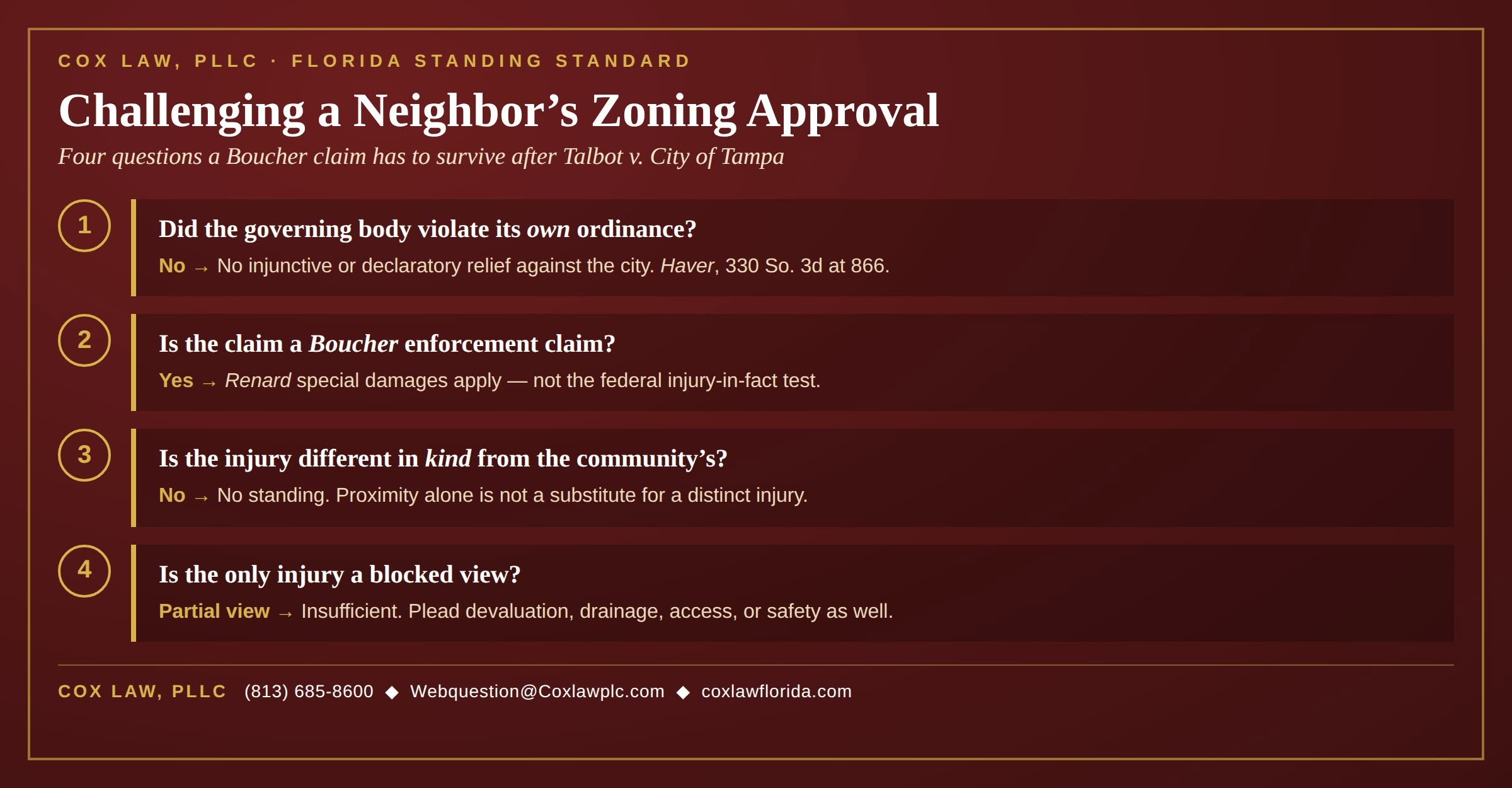
If you are challenging a neighboring approval — including for a COA, HOA, or land-use file — the Florida standing standard is the first hurdle, not an afterthought. Do not plead aesthetics and stop.
Plead a violation of the ordinance itself, not a bad result under a lawfully granted variance. Plead special damages with specifics: devaluation, drainage, access, safety, light and air tied to a distinct property effect. A clipped rooftop view, without more, will not get you through the courthouse door in the Second District.
Preserve your objection at the variance hearing and appeal it. Talbot relied on a developer’s assurance instead of the record, and by the time the building went up the window to challenge the variance had closed.
Watch the certified question. A Supreme Court answer adopting the federal test in place of the Florida standing standard would unsettle a run of recent standing dismissals, especially in the Fourth District. If you have a pending appeal that turns on which test applies, preserve the issue now. Contact Cox Law, PLLC if you need help evaluating how the Florida standing standard affects a zoning, association, or land-use dispute.
Read the Opinion
The opinion runs 45 pages and walks the Florida standing standard forward from Boucher and Renard through Kuhnlein, Johnson, Public Defender, and Haver. It is worth reading in full before you brief a standing issue in any district.
Standing Is Decided Before the Merits
Variance challenges, association enforcement, and land-use appeals are won or lost on special damages and the Florida standing standard. We review the ordinance, the record, and the injury before you file.
Request a ConsultationThis post is for general information only and is not legal advice. Reading it does not create an attorney-client relationship. Opinions are subject to revision before official publication.