

Gimeno vs. NCH MD is the Eleventh Circuit’s 2022 answer to a question that had lingered since CIGNA v. Amara: when an employer’s HR department botches a life insurance enrollment and the insurer refuses to pay, can the beneficiary recover the lost benefit from the employer as “appropriate equitable relief” under ERISA § 502(a)(3)? The court said yes. Below is our four-part brief of the case: facts, issues, holding, and rationale.
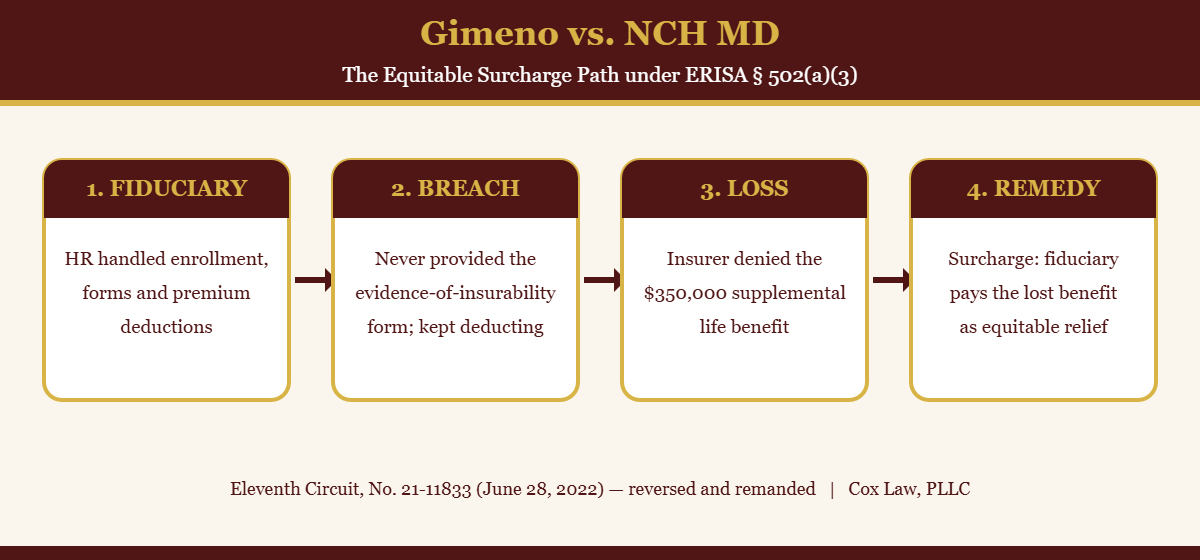
Table of Contents
Gimeno vs. NCH MD at a Glance
| Case | Gimeno v. NCHMD, Inc., No. 21-11833 (11th Cir. June 28, 2022) |
| Court | United States Court of Appeals for the Eleventh Circuit (appeal from the Southern District of Florida) |
| Panel | Chief Judge William Pryor, Judge Rosenbaum, and Judge Brasher (opinion by Judge Brasher) |
| Statute | ERISA § 502(a)(3), 29 U.S.C. § 1132(a)(3) |
| Disposition | Reversed and remanded |
Facts of Gimeno vs. NCH MD
Raniero Gimeno’s spouse, Dr. Justin Polga, was a physician employed by NCHMD, Inc., a subsidiary of NCH Healthcare System, Inc. When Dr. Polga was hired, NCHMD’s human resources department walked him through enrollment in the company’s group life insurance plan, an employee benefit plan governed by ERISA. He named Gimeno as his primary beneficiary.
Dr. Polga elected $350,000 in supplemental life insurance on top of $150,000 in employer-paid basic coverage, for $500,000 in total. Under the plan, supplemental coverage required an evidence-of-insurability form. According to the complaint, HR never gave Dr. Polga the form and never told him one was required. NCHMD nonetheless deducted premiums for the full $500,000 from his paychecks for three years and issued a benefits summary confirming $500,000 in coverage.
When Dr. Polga died, Gimeno filed a claim. The insurer paid the basic benefit but refused to pay the $350,000 supplemental benefit because it had never received the evidence-of-insurability form.
Procedural history. Gimeno sued NCHMD and NCH Healthcare System in the Southern District of Florida under ERISA § 502(a)(1)(B), which allows a participant or beneficiary to recover “benefits due to him under the terms of his plan.” The district court dismissed: the plan’s terms did not entitle Gimeno to supplemental benefits, because the form was never submitted, and the insurer, not the employer, was the party that paid benefits. Gimeno asked for leave to amend to plead a breach-of-fiduciary-duty claim under § 502(a)(3). The district court denied leave as futile, reasoning that the money Gimeno wanted was compensatory, not “equitable,” and therefore unavailable under that subsection. Gimeno appealed.
Issues
The dispute in Gimeno vs. NCH MD boiled down to two questions:
- Does “appropriate equitable relief” under ERISA § 502(a)(3) include a monetary award against a plan fiduciary equal to the benefits a beneficiary lost because of the fiduciary’s breach (the remedy known in trust law as surcharge)?
- If so, did Gimeno plausibly allege that NCHMD acted as a fiduciary when its HR department handled Dr. Polga’s enrollment, and did he lack an adequate remedy elsewhere in ERISA?
Holding
Yes on both counts. The Eleventh Circuit held that a beneficiary of an ERISA plan may sue a fiduciary under § 502(a)(3) to recover benefits lost because of the fiduciary’s breach of duty, and that this monetary make-whole remedy, surcharge, is “appropriate equitable relief” within the meaning of the statute. Because Gimeno had adequately alleged that NCHMD was acting as a fiduciary and had no remedy under § 502(a)(1)(B), the proposed amendment was not futile. The court reversed the denial of leave to amend and remanded.
Rationale
“Equitable relief” means the remedies equity courts actually gave. The court started from the Supreme Court’s rule that “appropriate equitable relief” refers to the categories of relief typically available in equity before the merger of law and equity. Compensatory damages were a legal remedy. But equity was not allergic to money: a court of equity could “surcharge” a trustee, ordering the trustee to pay the beneficiary for a loss caused by a breach of trust. Surcharge is therefore equitable in character and enforceable against a trustee in a court sitting in equity.
Amara settled the question. In CIGNA Corp. v. Amara, 563 U.S. 421 (2011), the Supreme Court explained that an order requiring a plan administrator to pay benefits it had promised in defective notices “closely resembles” surcharge and falls within § 502(a)(3). The Court stressed that the defendant’s fiduciary status makes the “critical difference”: relief that is legal against a stranger to the trust can be equitable against a trustee.
Mertens and Great-West are distinguishable. NCHMD leaned on Mertens v. Hewitt Associates and Great-West Life & Annuity Insurance Co. v. Knudson, both of which refused to treat money awards as equitable relief. The Eleventh Circuit answered that neither case involved a claim against a fiduciary, and Amara made clear that fiduciary status is what changes the analysis.
The circuits agree. The court observed that every circuit to consider the issue since Amara, including the Second, Fourth, Fifth, Seventh, Eighth, and Ninth Circuits, has recognized that § 502(a)(3) permits monetary relief for a fiduciary’s breach. Gimeno vs. NCH MD brought the Eleventh Circuit into that consensus.
Fiduciary status is functional, not a job title. Under ERISA § 3(21)(A), an entity is a fiduciary to the extent it exercises discretionary authority or control over plan administration. Courts look at what the defendant actually did. Here, as alleged, HR handed out the enrollment materials, guided Dr. Polga through the forms, notified employees of missing documents, distributed benefits summaries, and processed premium deductions. Those are plan-administration functions, and the court found them comparable to the employer conduct that established fiduciary status in Hamilton v. Allen-Bradley Co.
No adequate remedy elsewhere. Section 502(a)(3) is a “catchall” that yields when another ERISA provision offers adequate relief. Gimeno had none. He could not recover under § 502(a)(1)(B), because the plan’s terms did not cover him; the form was never filed. His grievance was not that the plan owed him benefits, but that a fiduciary’s breach prevented him from ever becoming entitled to them. That is precisely the gap surcharge exists to fill.
Why Gimeno vs. NCH MD Matters in Florida
For beneficiaries, the decision means an employer cannot collect three years of premiums, print a benefits statement showing $500,000 in coverage, and then shrug when the insurer points to a form nobody mentioned. If the employer was administering the plan, it can be surcharged for the benefit its breach cost the family. Equity, it turns out, keeps receipts.
For employers and plan sponsors, the case is a warning that the HR desk is a fiduciary desk. Guiding enrollment, deducting premiums, and issuing coverage summaries are discretionary plan-administration functions. An evidence-of-insurability requirement that is never communicated is a breach waiting to be litigated, and the employer’s liability runs to the full lost benefit, not just a refund of premiums.
For litigators, plead in the alternative. A § 502(a)(1)(B) claim for benefits under the plan and a § 502(a)(3) surcharge claim against the fiduciary are not duplicative when, as here, the plan’s terms do not reach the loss. And remember that Gimeno vs. NCH MD arrived at the motion-to-dismiss stage; on remand, Gimeno still had to prove the breach and the loss.
This is not the first time we have written about ERISA remedies. Our earlier posts on the Supreme Court’s decisions in Montanile and ERISA plan reimbursement claims and on an ERISA plan losing a reimbursement claim over dissipated settlement funds show the other side of the same coin: what “equitable” does and does not allow a plan to recover from a participant. If you are dealing with a denied life insurance claim or an employer benefits dispute, contact Cox Law, PLLC for a consultation.
What to Do After Gimeno vs. NCH MD

If you are a beneficiary facing a denied claim. Start by collecting every document that shows what the employer represented and what it collected: enrollment paperwork, the benefits summary or confirmation statement, and pay stubs reflecting the premium deductions. Those records were the heart of the complaint in Gimeno vs. NCH MD, and they are what turns a sympathetic story into a plausible fiduciary-breach claim.
Next, request the plan documents in writing. ERISA § 104(b)(4) requires the plan administrator to furnish the plan document, summary plan description, and insurance contract on request, and § 502(c)(1) allows a court to impose a penalty of up to $110 per day for an unexplained failure to respond within 30 days. Finally, pay attention to the clock. Fiduciary-breach claims are governed by ERISA § 413, which generally runs six years from the breach or three years from the date the plaintiff had actual knowledge of it, whichever is earlier. Do not assume the insurer’s denial letter is the last word; it is often the beginning of the employer’s exposure.
If you are an employer or plan sponsor. Audit the supplemental-coverage workflow. Every election that carries an evidence-of-insurability requirement should generate a written notice to the employee, a tracking entry for the form, and a follow-up before the first premium is deducted. Reconcile payroll deductions against the coverage the insurer actually has in force at least annually; a three-year mismatch like the one alleged in Gimeno vs. NCH MD is a red flag that internal controls are missing.
Train HR staff that their answers to benefits questions are fiduciary communications, and consider routing enrollment through the insurer’s own portal so that the carrier, not the employer, confirms whether coverage is approved. None of these steps is expensive. Each of them is far cheaper than defending a surcharge claim for the full face value of a policy.
If you are counsel. Plead the § 502(a)(3) claim with the specific administrative acts that make the employer a fiduciary, allege the causal link between the omission and the lost coverage, and ask for surcharge in the amount of the benefit rather than a return of premiums. Gimeno vs. NCH MD gives you the roadmap; the facts of your own case have to fill in the route.
Read the Opinion
The full opinion in Gimeno vs. NCH MD is available from the Eleventh Circuit (PDF) and on Justia. The Supreme Court’s opinion in CIGNA Corp. v. Amara, 563 U.S. 421 (2011), is the foundation for the court’s surcharge analysis. A copy of the Eleventh Circuit opinion is also archived below.
This case brief is provided for general informational purposes and is not legal advice. Reading it does not create an attorney-client relationship with Cox Law, PLLC.