

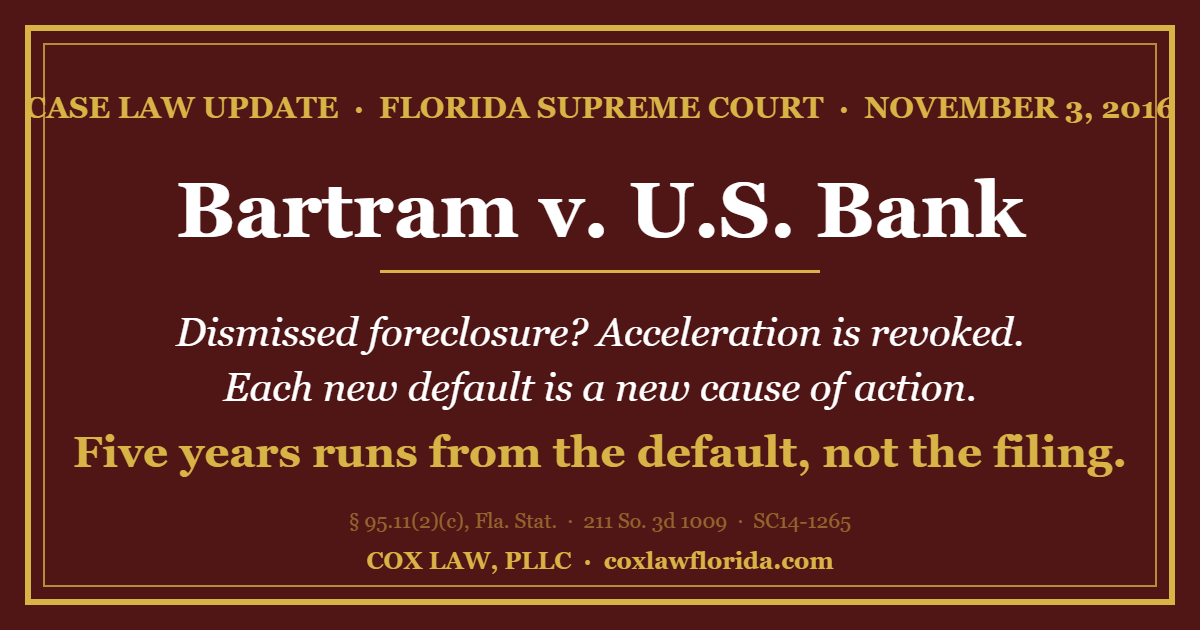
Bartram v. U.S. Bank, 211 So. 3d 1009 (Fla. 2016), settled one of the most litigated questions to come out of Florida’s foreclosure crisis: when a lender accelerates a mortgage, sues, and loses or is dismissed, does the five-year statute of limitations in section 95.11(2)(c) bar a second foreclosure? The Florida Supreme Court said no. This post traces the case from the Fifth District’s 2014 decision through the Supreme Court’s ruling and how the district courts have applied it since.
The Fifth District’s 2014 Decision
On April 25, 2014, the Fifth District Court of Appeal held that a default occurring after a failed foreclosure attempt creates a new cause of action for statute of limitations purposes, even where acceleration had been triggered and the first case was dismissed on the merits. U.S. Bank Nat. Ass’n v. Bartram, 140 So. 3d 1007, 1014 (Fla. 5th DCA 2014).
The Fifth District essentially gave the bank the right to file a new lawsuit, less those payments more than five years old, on a new breach occurring after the dismissal with prejudice. It then certified the following question to the Florida Supreme Court:
Does acceleration of payments due under a note and mortgage in a foreclosure action that was dismissed pursuant to rule 1.420(b), Florida Rules of Civil Procedure, trigger application of the statute of limitations to prevent a subsequent foreclosure action by the mortgagee based on all payment defaults occurring subsequent to dismissal of the first foreclosure suit?
Bartram v. U.S. Bank in the Florida Supreme Court
In Bartram v. U.S. Bank, N.A., No. SC14-1265 (Fla. Nov. 3, 2016), the Florida Supreme Court, in an opinion by Justice Pariente, answered the certified question in the negative and approved the Fifth District. A mortgagee is not barred by the five-year statute of limitations from filing a subsequent foreclosure action based on payment defaults occurring after the dismissal of the first action, provided those defaults fall within five years of the new suit.
The Court extended the reasoning of Singleton v. Greymar Associates, 882 So. 2d 1004 (Fla. 2004), from res judicata to the statute of limitations. Key points from the opinion:
- Dismissal of a foreclosure action revokes the acceleration and returns the parties to their pre-acceleration positions: the borrower may resume installment payments, and the lender may accelerate again based on “subsequent and separate” defaults.
- Whether the first dismissal was with or without prejudice is “not material” for limitations purposes. What matters is whether the new action rests on defaults that occurred after the dismissal.
- The standard mortgage’s reinstatement clause (paragraph 19), which lets the borrower cure “as if no acceleration had occurred,” supports treating the loan as an installment obligation absent a final judgment.
- Each new default gives rise to its own cause of action, and the statute of limitations runs from each default date, not from the original acceleration.
For further analysis, see “Foreclosing Bartram,” The Florida Bar Journal.
How the District Courts Have Applied Bartram v. U.S. Bank
The district courts quickly applied Bartram v. U.S. Bank to a range of pleading scenarios. In Desylvester v. Bank of New York Mellon, No. 2D15-5053 (Fla. 2d DCA Feb. 22, 2017), the Second District affirmed a foreclosure judgment where the complaint alleged a 2008 default “and all subsequent payments due thereafter,” even though the original default date fell outside the five-year window. Because the borrowers remained in continuing default, the allegation was sufficient to bring the action within the limitations period under Bartram.
Practical Takeaways from Bartram v. U.S. Bank
- For lenders: a dismissal, even with prejudice, does not end the right to foreclose. Plead the post-dismissal default dates, or the original default “and all subsequent payments,” and confine recovery to installments within five years of filing.
- For borrowers: the statute of limitations defense after a dismissed foreclosure is narrow. It can eliminate installments more than five years old, but it will not extinguish the mortgage while the loan remains in default.
- Deficiency claims are different: section 95.11(5)(h) imposes a separate one-year period on deficiency actions for one- to four-family residential property, running from the clerk’s certificate or a deed in lieu.
Briefs and Full Opinion
- Petitioner’s Initial Brief on the Merits (PDF)
- Respondent’s Answer Brief on the Merits (PDF)
- Read the full opinion: Bartram v. U.S. Bank National Ass’n, SC14-1265 (Fla. Nov. 3, 2016)
The Florida Supreme Court’s Bartram v. U.S. Bank opinion may also be downloaded here: