

You have found a page that has nothing whatsoever to do with Florida law. Since you are here, you may as well learn something.
The Man
Edward Teach — recorded variously as Thatch, Thache and Thack — was born around 1680, probably in Bristol. He went to sea as a British privateer, a lawful commerce raider operating under government licence, and slid into outright piracy when the wars ended and the licences did not. He sailed under Benjamin Hornigold from roughly 1713, and by about 1716 had his own command.
In November 1717 he took the French slave ship La Concorde, fitted her with forty guns and renamed her Queen Anne’s Revenge. At his height he commanded roughly three hundred men. In May 1718 he blockaded the harbour at Charleston, seizing ships and hostages and extracting a ransom from the colonial government that consisted largely of a chest of medicine.
He then accepted a pardon from Governor Charles Eden of North Carolina and promptly went back to work — taking the offer, as one early account put it, only to wait for a better opportunity to play the same game again. On 22 November 1718, at Ocracoke Inlet, Royal Navy Lieutenant Robert Maynard cornered him. Teach reportedly took twenty cutlass wounds and five pistol balls before he went down. His head was cut off and hung from Maynard’s bowsprit.
He was active as a pirate captain for roughly two years.
The Flag
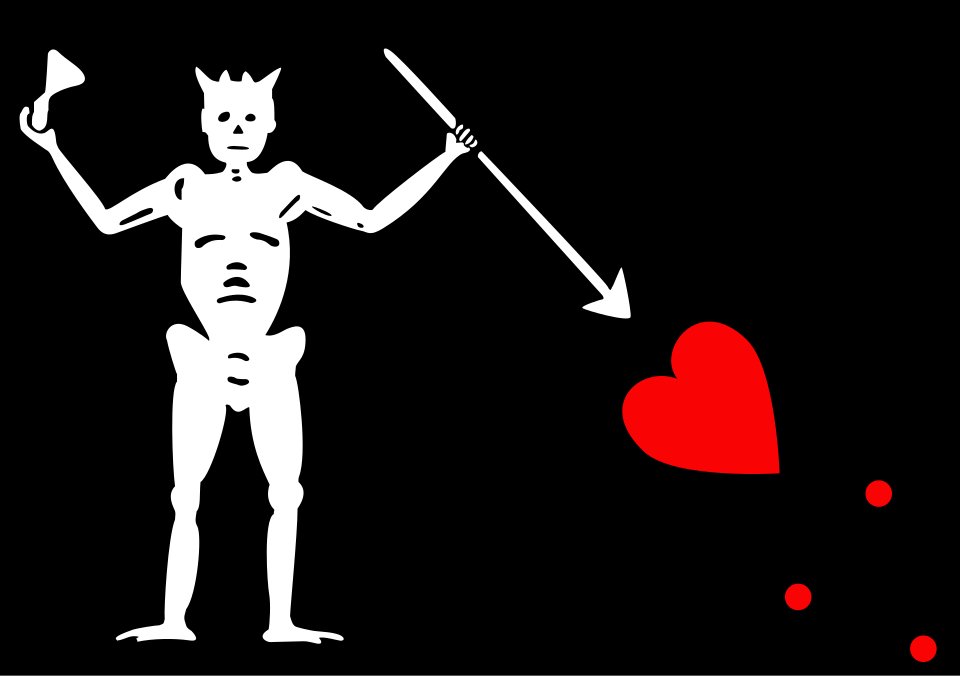
Here is the part worth knowing. The horned skeleton above — hourglass in one hand, spear through a bleeding heart in the other — is on mugs, tattoos, book covers and theme park signage as Blackbeard’s flag. No eighteenth century source says it was.
The design first turns up in print in a 1912 article in The Mariner’s Mirror, presented as a generic pirate flag with no connection to Teach at all. The attribution to Blackbeard appears to have attached itself in the 1970s, through books and television, and then hardened into common knowledge. Historian E.T. Fox has pointed out that the image is internally incoherent as period iconography: in eighteenth century art the horned devil was not drawn as a skeleton, and skeletal Death was not given horns. The two figures have been welded together by someone who was not working from life.
What the contemporary record actually gives us is plainer. A 1718 newspaper account of the Queen Anne’s Revenge describes “Black Flags and Deaths Heads in them and three more Sloops with Bloody Flags” — a black flag, a skull, and red flags signalling no quarter. Standard equipment for the trade.
Why This Is Here
The image turned up where it did not belong, on a page about supervisor liability. Rather than delete it, we gave it somewhere to live.
There is a lesson in it for the day job, if you want one. A claim repeated confidently for fifty years is still not evidence. Ask where it first appeared, and who said so at the time.
There is some overlap between the two trades. Both operate under a licence, both are paid out of what they take, and both have been known to fly a flag the evidence does not quite support. Blackbeard’s strategies are therefore somewhat applicable — and in any event, we are history buffs here at Cox Law, PLLC.
Sources
- Queen Anne’s Revenge Project (North Carolina Department of Natural and Cultural Resources), “Did You Know Blackbeard’s Flag is a Modern Design?”
- Royal Museums Greenwich, “Who was Blackbeard?”