
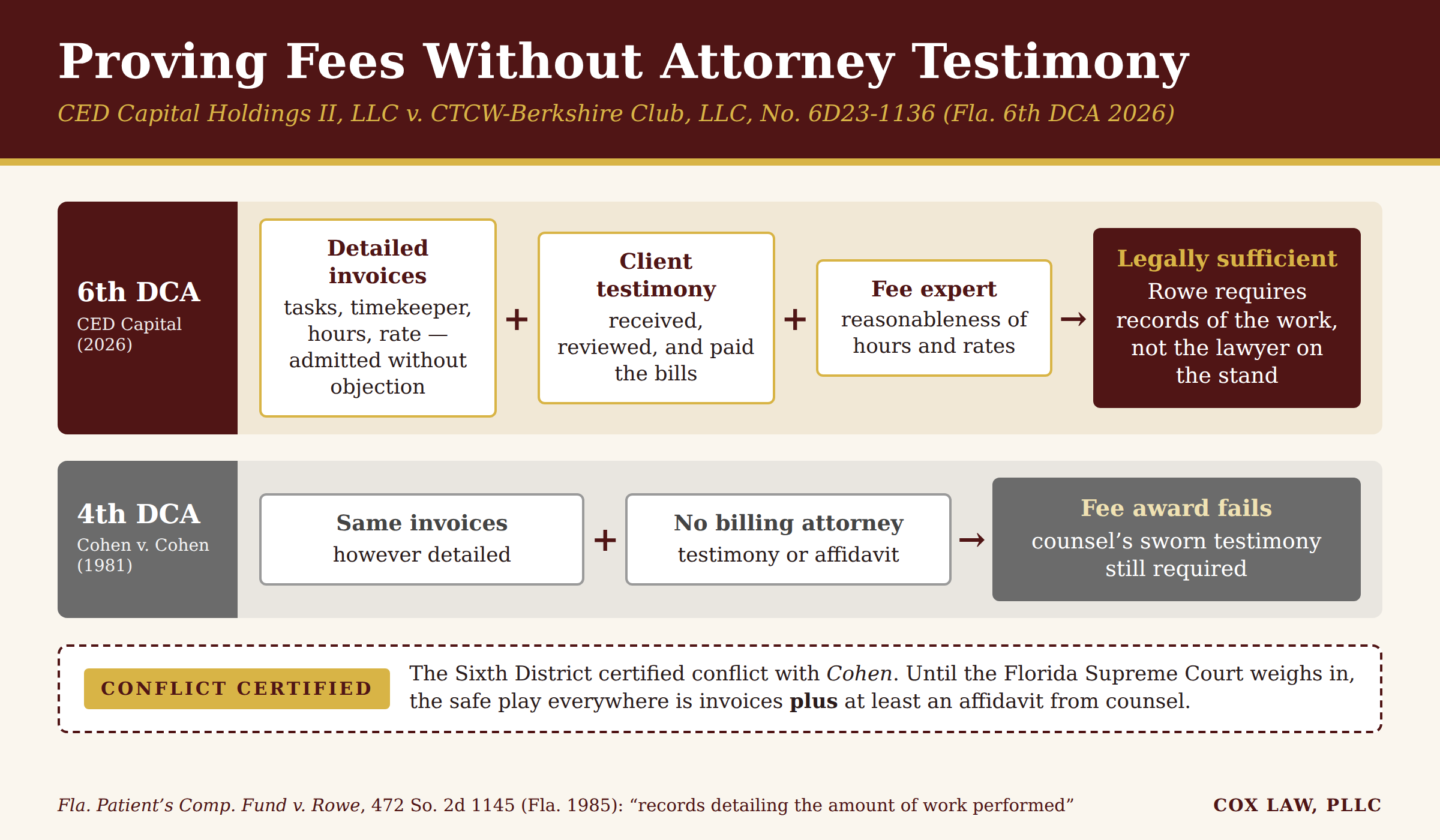
Can a party recover attorney fees without attorney testimony in Florida? In CED Capital Holdings II, LLC v. CTCW-Berkshire Club, LLC, No. 6D23-1136 (Fla. 6th DCA 2026), the Sixth District Court of Appeal said yes: when detailed invoices describing the tasks, timekeepers, hours, and rates are admitted into evidence without objection, the fee applicant does not also need the billing attorneys to take the stand. The court certified conflict with the Fourth District, so this question may be headed to the Florida Supreme Court.
The Facts
CED sued CTCW for breach of a partnership agreement that contained a prevailing-party attorneys’ fees provision. CED prevailed and filed a motion seeking nearly $900,000 in fees. At the two-day evidentiary hearing, CED’s manager (Brian Spear) testified that he received, reviewed, and paid the detailed invoices from CED’s counsel. The invoices—admitted into evidence without limitation or relevant objection—identified each task performed, the timekeeper, the exact time spent, and the hourly rate. CED also presented expert testimony from attorney Robert Stovash, who opined on the reasonableness of the hours and rates.
No attorney who actually performed the work testified, and CED did not introduce the attorneys’ affidavits that had been attached to the original motion. The trial court denied the fee motion, ruling that the evidence was legally insufficient because no CED attorney testified to detail the services performed and no attorney affidavit was admitted. The court never reached the second step of the lodestar analysis (reasonableness of hours and rates).
The Issue
Whether, under Florida law, a party seeking attorneys’ fees must present live testimony (or an affidavit) from the attorneys who performed the work when detailed invoices that fully describe the tasks, timekeepers, hours, and rates have already been admitted into evidence without limitation.
The Rule: Proving Attorney Fees Without Attorney Testimony
Florida Supreme Court precedent in Florida Patient’s Compensation Fund v. Rowe, 472 So. 2d 1145 (Fla. 1985), governs: to determine the number of hours reasonably expended (first step of the lodestar method), “the attorney fee applicant should present records detailing the amount of work performed.” No Supreme Court decision imposes an additional requirement that the attorneys who performed the work must testify. Detailed business records that describe the specific tasks, individuals, time, and rates constitute legally sufficient evidence of the work performed once properly admitted without limitation. The Sixth District is not bound by conflicting decisions from sister courts.
The Analysis
The Sixth District reviewed the issue de novo as a pure question of law. It declined to follow the line of cases (originating with Lyle v. Lyle, 167 So. 2d 256 (Fla. 2d DCA 1964), and followed by the Fourth District in Cohen v. Cohen, 400 So. 2d 463 (Fla. 4th DCA 1981), and others) that treated attorney testimony as mandatory. Those decisions lack support in any statute or rule and rest on an unduly narrow conception of “legally sufficient evidence.”
Here, the invoices supplied exactly the records Rowe requires and were received into evidence without condition. The manager’s testimony established that the invoices were received and paid, and the expert addressed overall reasonableness. Because the invoices themselves proved the nature and extent of the services performed, the trial court erred in denying the motion solely for lack of attorney testimony.
The Conclusion
Reversed and remanded for the trial court to complete the lodestar analysis (i.e., determine whether the hours expended and hourly rates were reasonable). The Sixth District certified conflict with the Fourth District’s decision in Cohen v. Cohen on the issue of whether counsel’s sworn testimony is required to support a fee award.
What This Means for You
For litigants and counsel seeking attorney fees without attorney testimony, the practical lesson is to build the record carefully. Get the detailed invoices admitted into evidence, ideally without objection, and make sure they show what work was done, who did it, how long it took, and at what rate. Pair that with testimony from a fee expert on reasonableness.
Under Rowe, that record can be legally sufficient on its own, at least in the Sixth District. Because the Fourth District still follows Cohen, however, parties litigating in that district (or in a district that has not yet addressed the question) should be prepared to call the billing attorney or submit an affidavit until the Florida Supreme Court resolves the conflict. The safest course everywhere remains to offer both the invoices and at least an affidavit from counsel.
The full opinion is attached here: