

Florida lawyers who came up taking county court appeals to a three-judge circuit court appellate panel are working from an outdated map. Since January 1, 2021, the circuit court’s role as an intermediate appellate court for county court judgments has been eliminated. Final county court orders in civil and criminal cases are now appealed directly to the district court of appeal. The change came from Senate Bill 1392, chapter 2020-61, Laws of Florida, which amended section 26.012, Florida Statutes, and repealed section 924.08.
What the Legislature Actually Did
Article V, section 4(b)(1) of the Florida Constitution gives the district courts of appeal jurisdiction over appeals from final trial court orders “not directly reviewable by the supreme court or a circuit court.” Circuit court appellate jurisdiction, by contrast, exists only “as provided by general law.” The legislature therefore did not need to grant the district courts anything. It only had to take the authority away from the circuit courts and let the constitutional default fill the gap.
That is what SB 1392 did. It struck the language in section 26.012(1) that had given circuit courts jurisdiction over appeals from county courts, and it repealed section 924.08, which had supplied parallel authority for misdemeanor judgments. The circuit court appellate divisions that once absorbed small claims, county civil, misdemeanor, and traffic appeals lost that docket by operation of law. County court appeals did not disappear; they changed address.
Where County Court Appeals Go Now
County court appeals from final orders, civil and criminal alike, go to the district court of appeal serving that county. The notice of appeal is still filed with the clerk of the county court within 30 days of rendition under Florida Rule of Appellate Procedure 9.110(b), or rule 9.140(b)(3) in criminal cases. Everything after that is district court practice: the record is prepared under rule 9.200, briefs must satisfy the format and word-count limits of rule 9.210, and filing runs through the appellate e-portal.
Nonfinal county court orders follow rule 9.130 to the same district court, so both final and nonfinal county court appeals now share a single forum. A county court may still certify a question of great public importance, and the district court has discretionary jurisdiction to review an order so certified under rule 9.030(b)(4).
County Court Appeals at a Glance
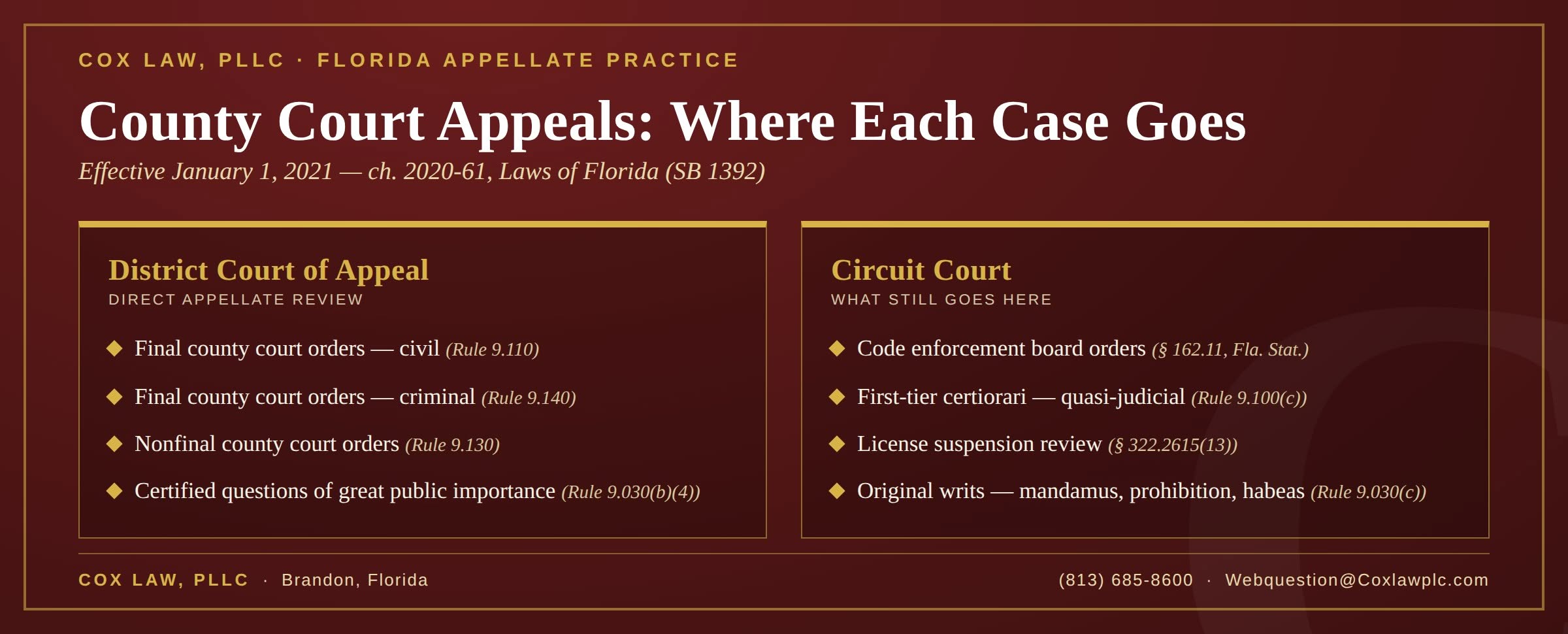
The chart above sorts the two dockets. Anything that begins as a final or nonfinal county court order is now a district court matter. Anything that reaches the circuit court in a review capacity — code enforcement, first-tier certiorari, license suspension — is not one of the county court appeals affected by SB 1392, even though it often lands on the same practitioner’s desk.
What the Circuit Court Still Reviews
The circuit court’s appellate capacity was narrowed, not abolished. Three categories survive, none of them county court appeals, and confusing them with the old county court practice is the most common error we see.
Code enforcement appeals. Section 162.11, Florida Statutes, still routes appeals from final administrative orders of local code enforcement boards to the circuit court. Review is on the record made below, not a hearing de novo, and the notice must be filed within 30 days of execution of the order appealed.
First-tier certiorari. Quasi-judicial decisions of local government — rezonings, variances, special exceptions, site plan denials, and similar site-specific determinations — are reviewed by petition for writ of certiorari filed in the circuit court under rule 9.100(c), within 30 days of rendition. The circuit court asks three questions: whether procedural due process was accorded, whether the essential requirements of law were observed, and whether competent substantial evidence supports the decision. Administrative suspensions of a driver license reach the circuit court the same way under section 322.2615(13).
Other review expressly given by general law, together with the circuit court’s original writ jurisdiction — mandamus, prohibition, quo warranto, habeas corpus, and common law certiorari — under rule 9.030(c).
Second-Tier Certiorari Is Now the Exception
Where the circuit court does sit in a review capacity, the district court’s role is second-tier certiorari under rule 9.030(b)(2)(B): whether the circuit court afforded procedural due process and applied the correct law. That is a deliberately narrow lens, and it is not a second appeal. A circuit court’s merely erroneous ruling is not reviewable; a departure from the essential requirements of law resulting in a miscarriage of justice is.
For county court appeals that lens no longer applies at all. There is no intermediate circuit court decision to review, so the district court is the court of first and last appellate resort, subject only to the supreme court’s discretionary jurisdiction on express conflict or a certified question.
Why County Court Appeals Now Carry More Weight
Circuit court appellate decisions were never binding precedent outside the circuit that issued them, and most were never published. District court decisions are different. Under Pardo v. State, 596 So. 2d 665 (Fla. 1992), a district court decision binds every trial court in the state where no contrary decision exists in that trial court’s own district.
The practical consequence is that a contested four-thousand-dollar small claims judgment can now generate a written opinion that governs county courts statewide. Counsel on both sides should brief county court appeals with that audience in mind. The flip side is cost: district court briefing is more demanding than most circuit appellate panel practice ever was, and the client should understand that exposure before the notice of appeal is filed.
The Jurisdictional Amount Raises the Stakes
The forum change did not happen in isolation. Section 34.01, Florida Statutes, raised the county court’s civil jurisdictional limit to $30,000 for causes of action accruing on or after January 1, 2020, and to $50,000 for those accruing on or after January 1, 2023. A docket that once stopped at $15,000 now reaches $50,000, and every judgment in that range is appealed straight to the district court. County court appeals therefore involve larger sums and binding statewide precedent at the same time — a combination that did not exist five years ago. Counsel should tell the client at intake that county court appeals now cost what district court appeals cost, because that is what they are.
Practice Points
- Confirm the forum before the thirtieth day. County court appeals belong in the district court; a notice directed to the wrong court is not automatically fatal, because rule 9.040(b) provides for transfer, but it costs time and credibility.
- Preserve the issue below. The district court will not reach an unpreserved argument, and county court records are often thin. Make the objection, get the ruling, and move for rehearing where the order lacks findings.
- Order the transcript immediately. County court proceedings are frequently recorded rather than reported, and obtaining a usable transcript or a rule 9.200(b)(5) statement of the evidence takes longer than counsel expect.
- Separate appeal from certiorari at the outset. Filing a notice of appeal when the correct vehicle is a certiorari petition, or the reverse, is the recurring trap in the local government context.
- Check your old forms. Any template still styling the case as an appeal to the circuit court in its appellate capacity needs to be retired.
- Reserve fee entitlement. A motion for appellate attorney fees must be served under rule 9.400(b) and must state the substantive basis for entitlement.
Talk to a Florida Appellate Lawyer
Appellate deadlines are jurisdictional and they run from rendition, not from the day the client decides to appeal. If you have a county court judgment, a code enforcement order, or a local government decision you are considering challenging, contact Cox Law, PLLC or call 813-685-8600 for a review of your options and the deadline that applies. We handle county court appeals, certiorari petitions, and district court practice throughout the Tampa Bay area.

This article is provided for general information and is not legal advice. Appellate jurisdiction and deadlines are fact-specific; county court appeals and certiorari review each carry their own requirements, so consult counsel about your own matter.