


A 1031 exchange is one of the most powerful — and most easily botched — tools available to a Florida real estate investor. Done correctly, it lets an owner sell appreciated investment property and roll the entire proceeds into replacement property without paying federal capital gain tax in the year of sale. Done carelessly, it produces a fully taxable sale, a surprised client, and a tax bill that arrives long after the closing proceeds have been spent. This article walks through how the mechanism actually works, where the deadlines bite, and what Florida owners in particular need to keep in view.
What a 1031 Exchange Actually Does
The authority is Internal Revenue Code § 1031, which since 2018 has carried the heading “Exchange of Real Property Held for Productive Use or Investment.” The operative language is short: no gain or loss is recognized on the exchange of real property held for productive use in a trade or business or for investment, if that property is exchanged solely for real property of like kind to be held for the same purposes.
The word to underline is recognized. A 1031 exchange defers tax; it does not forgive it. Under § 1031(d) the basis of the old property carries over into the new one, so the untaxed gain rides along and surfaces whenever the replacement property is eventually sold in a taxable transaction.
What deferral buys is the use of money that would otherwise have gone to the Treasury — the full sale proceeds keep working in the next asset, compounding. Investors who exchange repeatedly, and whose heirs receive a stepped-up basis at death under § 1014, may never pay the deferred tax at all. That outcome is a consequence of the estate plan, not of § 1031 itself, and it should be planned deliberately rather than assumed.
Deferral also reaches the taxes that ride on top of capital gain: the 25% rate on unrecaptured § 1250 gain from prior depreciation, and the 3.8% net investment income tax. On a long-held rental with heavy accumulated depreciation, those two items are frequently a larger share of the bill than the capital gain rate itself.
Only Real Property Qualifies — and Not All of It
The Tax Cuts and Jobs Act narrowed § 1031 to real property for exchanges completed after 2017. Equipment, vehicles, franchise rights, artwork, livestock, and other personal or intangible property no longer qualify. Treasury’s final regulations define real property to include land, improvements to land, unsevered natural products, and intangible interests such as easements and options that derive their value from, and are inseparable from, the underlying real estate.
Two refinements matter in practice. Personal property that is incidental to the real estate — the appliances and furnishings customarily transferred with it — is disregarded if its aggregate fair market value does not exceed 15% of the replacement real property. And United States real property and foreign real property are not like kind to each other, which ends the exchange for a client who wants to trade a Tampa duplex for a condominium abroad.
Within domestic investment real estate, the like-kind test is generous. Raw land can be exchanged for a strip center, a rental duplex for a warehouse, a leasehold of thirty years or more for a fee interest. What falls outside is defined by holding purpose, not property type: a primary residence, property held primarily for sale (the flipper’s inventory), and partnership interests are all excluded. The taxpayer’s intent to hold for investment is a question of fact, and it is proved with documents created before the closing, not after.
The Two Deadlines That End Most 1031 Exchanges
Almost every failed 1031 exchange fails on the calendar. Two periods begin running the day the relinquished property transfers, and they run concurrently.
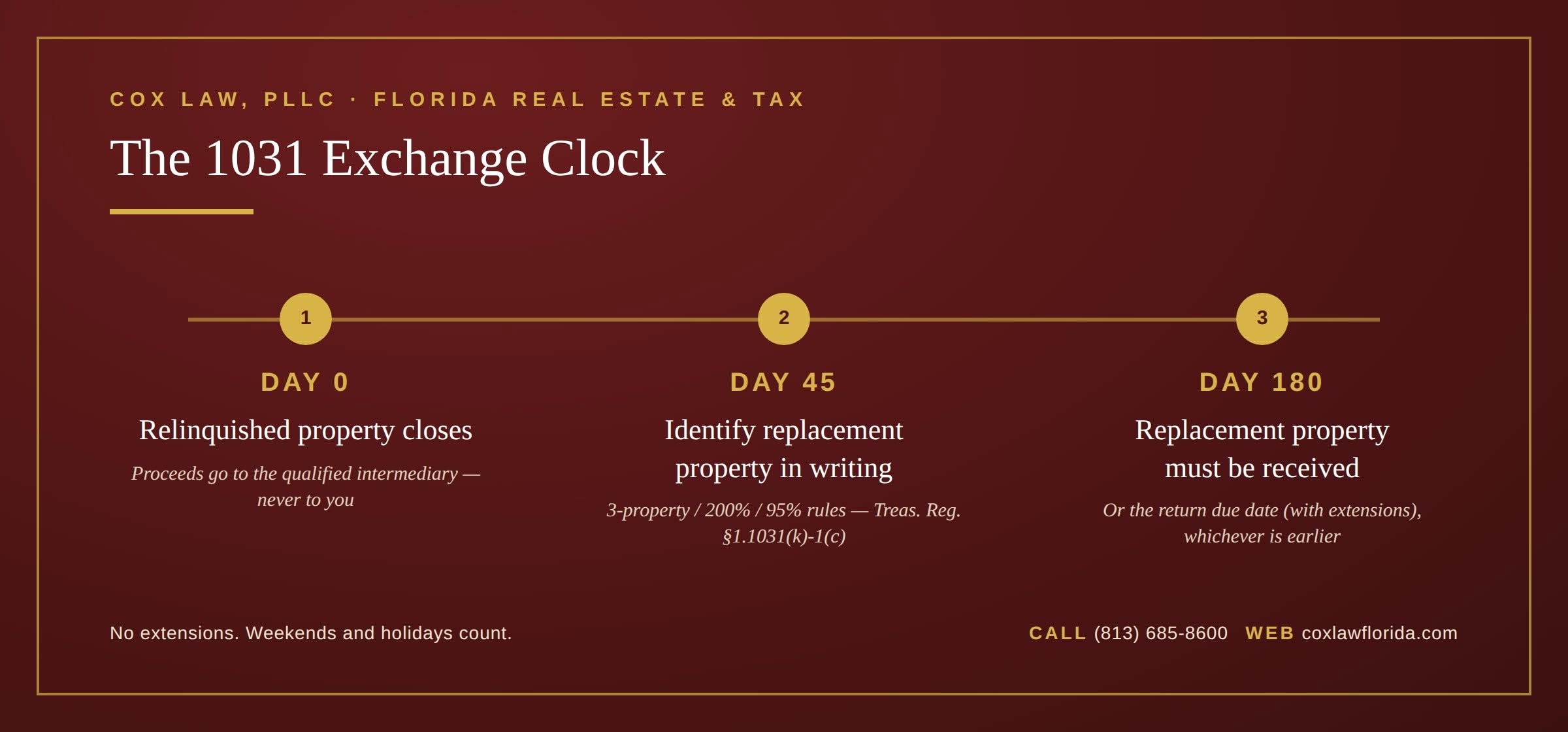
Forty-five days to identify. The replacement property must be designated in writing, signed, and delivered to the qualified intermediary or another party to the exchange, describing the property in a clear and recognizable manner — a legal description, a street address, or a distinguishing name. The identification regulations cap the field: three properties of any value, or any number of properties whose combined fair market value does not exceed 200% of the relinquished property, or, failing both, properties actually acquired amounting to at least 95% of what was identified.
One hundred eighty days to close. The replacement property must be received by the earlier of 180 days after the transfer or the due date, including extensions, of the return for the tax year in which the transfer occurred. That second limb catches people. A closing in November or December gives a taxpayer far less than 180 days unless the return is extended — extending the return is the fix, and it has to be done before the original due date.
Neither period is extendable by agreement, by hardship, or by a cooperative seller. Weekends and holidays count. The only relief comes from IRS disaster declarations, which are published and specific. Plan the 1031 exchange replacement search before the relinquished property goes under contract, not after.
You Cannot Touch the Money: The Qualified Intermediary
A sale followed by a purchase is not a 1031 exchange. If the seller receives the proceeds, or has the right to draw on them, the doctrine of constructive receipt makes the transaction taxable no matter how quickly the money is reinvested. The practical solution is the qualified intermediary safe harbor: a written exchange agreement, executed before the relinquished closing, under which the intermediary acquires and transfers the properties and holds the funds subject to express restrictions on the taxpayer’s right to receive them. (Edward Tech would have understood the rule instinctively — the moment the treasure comes aboard your own ship, it is yours, and someone is going to want a share of it.)
Two cautions apply. First, the intermediary cannot be a disqualified person — generally the taxpayer’s agent, including an attorney, accountant, or broker who has served the taxpayer within the two years before the transfer. Second, qualified intermediaries are not licensed, bonded, or regulated in Florida, and exchange funds have been lost to intermediary insolvency and misappropriation. Ask for segregated qualified escrow accounts, a fidelity bond, errors-and-omissions coverage, and dual authorization on disbursements before wiring anything.
Boot, Debt, and the Cost of Trading Down
Gain is recognized to the extent of “boot” — money or non-like-kind property received in the 1031 exchange. Cash left over at the end of the exchange period is boot. So is net debt relief: if the relinquished property carried a $600,000 mortgage and the replacement carries $400,000, the $200,000 of relief is treated as money received unless offset by new cash invested. The working rule of thumb is to go equal or up in value, equal or up in debt, and reinvest all of the net proceeds.
A partial 1031 exchange is permitted and sometimes sensible — a client who needs cash at closing can take it and accept tax on that slice. What should not happen is accidental boot, which most often comes from the settlement statement: seller credits, prorated rents, security deposits transferred, and loan-acquisition costs paid from exchange funds can all create recognized gain. Have the closing agent and the intermediary review the draft statement together before the numbers are final.
Related-Party Exchanges and the Two-Year Rule
Section 1031(f) applies when the 1031 exchange is with a related party — a spouse, ancestor, descendant, sibling, or a controlled entity. If either party disposes of the property received within two years after the last transfer, the deferred gain is pulled back into income in the year of the disposition. The statutory exceptions are narrow: a disposition after the death of either party, an involuntary conversion where the threat arose after the exchange, or a showing to the Service’s satisfaction that tax avoidance was not a principal purpose of either the exchange or the disposition.
The higher-risk pattern is buying replacement property from a related party, because it can shift basis within the family while the related seller pays little or no tax. Section 1031(f)(4) reaches transactions structured through an intermediary to sidestep the rule. Related-party exchanges are not prohibited, but they should be documented and reported with care, and the two-year clock belongs on a calendar.
Florida-Specific Points in a 1031 Exchange
No state income tax, no state clawback. Florida imposes no individual income tax, so for individual investors the deferral question is entirely federal. Florida has no analogue to the clawback statutes some states use to tax deferred gain when in-state property is exchanged for out-of-state property. Corporate owners should still coordinate with Florida’s corporate income tax, which is computed from federal taxable income.
Documentary stamp tax still applies. A 1031 exchange is a federal income tax concept; it is not a transfer tax exemption. Florida documentary stamp tax runs $0.70 per $100 of consideration on deeds statewide (Miami-Dade uses $0.60 per $100, plus a $0.45 surtax on property other than a single-family residence), and an exchange involves two conveyances. On an eight-figure trade, that is real money and it belongs in the pro forma from the start.
The same taxpayer must acquire. In a 1031 exchange, title to the replacement property must be taken by the taxpayer that relinquished the old property. A single-member LLC disregarded for federal tax purposes generally preserves the identity and gives welcome flexibility; a lender that insists on a new co-borrowing entity, or a spouse added to title, can break it. Raise vesting with the lender early, not at the closing table.
Residences and vacation rentals. A homestead is the province of the § 121 exclusion, not § 1031, though a property converted between uses can implicate both. Florida’s short-term rental stock raises this constantly; the IRS safe harbor for dwelling units generally requires, for each of the two years surrounding the exchange, rental at fair market value for at least 14 days and personal use held under the greater of 14 days or 10% of the rental days.
Put it in the contract. The purchase and sale agreement should contain exchange cooperation language and permit assignment of the contract to the intermediary. It costs nothing at the drafting stage and cannot be added after the deed records.
1031 Exchange Variations Worth Knowing About
Reverse exchanges. When the replacement property must be locked down before the old property sells, an exchange accommodation titleholder can “park” one of the properties under a published safe harbor, holding title for up to 180 days while the other leg closes. Reverse 1031 exchanges cost more and require financing that tolerates the parking entity, so start them early.
Improvement exchanges. Construction proceeds can be applied to improve the replacement property while it is parked, but only improvements actually in place when the taxpayer receives the property count toward the exchange value. Materials sitting in a yard on day 180 do not.
Fractional and passive replacement property. Delaware statutory trust interests and properly structured tenant-in-common interests can serve as replacement property, which is often the practical answer for an investor staring down day 45 with nothing identified. These are securities-like investments with real illiquidity; they deserve the same diligence as any other acquisition.
Partnerships that cannot agree. When some partners want out and others want to complete a 1031 exchange, the “drop and swap” — distributing tenant-in-common interests before the sale — is the usual structure, and its weakness is the holding-purpose requirement. If it is going to happen, it should happen well before the property is marketed.
What 2025 and 2026 Changed — and What They Didn’t
Section 1031 survived the 2025 tax legislation intact. Proposals to cap or repeal like-kind deferral circulated for several years; none was enacted, and the law signed on July 4, 2025 left the 1031 exchange rules unchanged while making the individual capital gain rate structure permanent. That is worth saying plainly to clients who have been told the 1031 exchange is disappearing. It is not gone, but it is a recurring target in deficit negotiations, and a client who has been contemplating a trade for three years should not assume the window is permanent.
Two adjacent changes are worth knowing. Full bonus depreciation was made permanent, which — combined with a cost segregation study — can shelter income on newly acquired property and sometimes reduces the pressure to exchange at all. And the opportunity zone program was made permanent on a rolling basis, with a new map of designations taking effect January 1, 2027 and the existing designations running through 2028.
An opportunity zone investment is a different instrument from a 1031 exchange: the original gain is recognized, only deferred for a period, and it is the new appreciation that escapes tax after ten years. For an investor selling a business or stock rather than real property, it may be the only deferral available; for an investor trading one building for another, § 1031 remains the cleaner path.
Practice Points
- Engage the qualified intermediary before the relinquished closing. After the deed records there is nothing to fix.
- Put exchange cooperation and assignment language in both contracts.
- Calendar day 45 and day 180 from the transfer date, and check whether the return due date shortens the second one.
- Identify more than one replacement property. The three-property rule exists because deals fall apart.
- Confirm the acquiring taxpayer and the vesting with the lender and the title agent in writing.
- Budget documentary stamp tax on both conveyances.
- Diligence the intermediary: segregated escrow, fidelity bond, E&O coverage, dual authorization.
- Report the 1031 exchange on Form 8824 for the year of the transfer, and coordinate the return extension if the timing requires it.
- If a related party is on either side, calendar the two-year period and document the non-tax-avoidance purpose contemporaneously.
Talk to a Florida Real Estate Attorney Before You Close
The mechanics of a 1031 exchange are not complicated, but they are unforgiving, and the decisions that determine whether the exchange works are made in the contract and at the intermediary engagement — weeks before anyone signs a closing statement. Cox Law, PLLC represents investors, landlords, and business owners throughout the Tampa Bay area in real estate acquisitions, dispositions, and the entity and contract work that surrounds them. If you are contemplating a sale of Florida investment property, contact our office or call 813-685-8600 to discuss the structure while there is still time to structure it.
Cox Law, PLLC · Florida Real Estate & Tax Attorneys
Selling Florida Investment Property?
A 1031 exchange is won or lost before the closing. The exchange agreement, the qualified intermediary, and the contract language all have to be in place while the deal is still being papered — and the 45-day and 180-day clocks do not stop for anyone.
Or call (813) 685-8600 · Webquestion@Coxlawplc.com
Further reading: the IRS overview of like-kind exchanges and real estate tax tips, and the Florida Department of Revenue’s guidance on documentary stamp tax.
This article is general information about Florida and federal law and is not legal or tax advice, and it does not create an attorney-client relationship. A 1031 exchange has significant tax consequences that depend on facts specific to each taxpayer; consult your own attorney and CPA before acting.